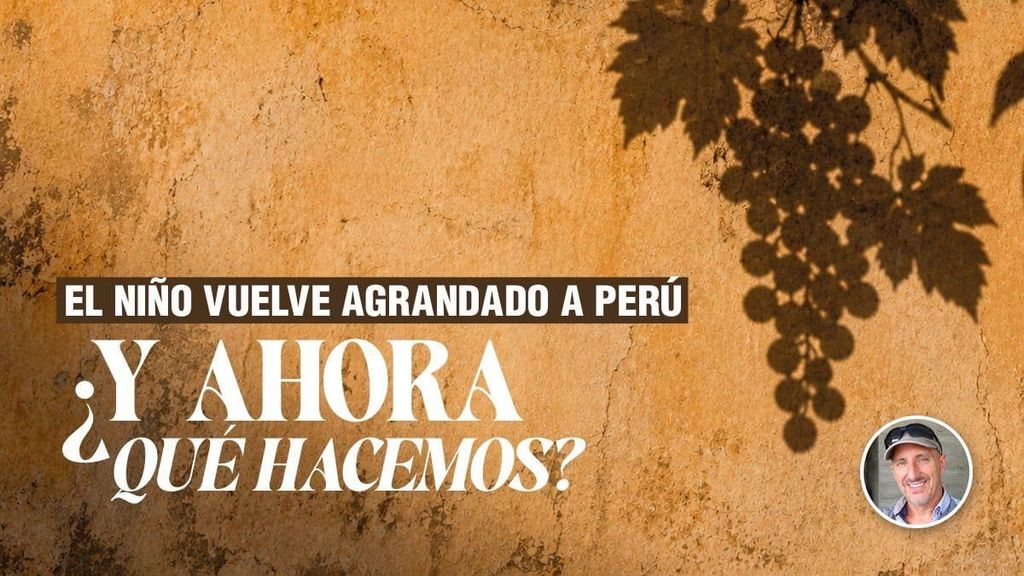
El Niño returns bigger to Peru: what do we do now?
Column by Tony Salas, published in Spanish in Vision Magazine Latam No. 37, Analysis section, September and October 2026 issue, pages 38 to 40. Read the original edition.
El Niño is testing Peruvian agroexports once again. Blueberries, grapes and avocados will face different impacts on quality, productivity and costs, but with one shared challenge: making today the decisions that will determine who comes out stronger and better prepared for the seasons ahead.
Beyond the terrible social and economic consequences for human lives, in farming El Niño does not discriminate. It will hit large and small growers hard. Growers of modern and traditional varieties alike. Blueberries in soil and fields in pots. Companies with 5 hectares and estates with 500. But the consequences will not be the same. Every business owner will have to define their own strategy.
Banks will be reviewing their collateral to decide who gets refinanced and who does not. Suppliers will do the same with their receivables. Exporters will be watching the condition of the fruit, and receivers will tighten inspections because they know Peruvian fruit will arrive carrying more risk. Meanwhile, growers will be counting their kilos.
El Niño does not hit the farmer alone; it hits the whole chain. And every link will have to manage its own risk.
Farming has spent thousands of years teaching us the same lesson: we do not control the weather, but we do control how we respond. We can decide where to invest, how much to spend, which variety to renew, how and what to prune, which harvest is worth taking and which is not. Some will lose fruit. Others will lose capital. And some will use a bad year to build the competitive advantage of the next five.
Because real resilience is not about surviving El Niño. It is about coming out of it better positioned than when we went in.
So the question is the same as ever: El Niño is coming. It is already here. What are we going to do? After crossing ourselves, of course.
The real problem is not the rain
In Peru we have had years to prepare. Yet infrastructure prevention against extreme weather events has advanced far less than it should have. And while we keep arguing about what should have been done, the farmer has to decide what to do with his own field. That political discussion could go on, especially in Peru after the end of the worst presidential period in the last 50 years and now on the doorstep of the biggest El Niño in the last 150. But the farming entrepreneur cannot wait.
When we talk about El Niño we almost always think of overflowing rivers, collapsed bridges or destroyed roads. That physical damage is real and can be enormous, especially if we depend on road logistics to move staff to the farms and containers to the port. But for export fruit crops the deeper problem happens inside the plant.
Most fruit species need a winter, even the modest Peruvian coastal winter. It is during that period that pest pressure drops, reserves build up and the physiological processes that allow proper floral differentiation are triggered.
With an intense El Niño exactly the opposite happens. Temperatures rise, the vapour pressure deficit (VPD) forces the plant to partly close its stomata to avoid dehydration, and CO2 intake falls. Rubisco loses efficiency, photorespiration increases and the plant starts consuming more energy than it manages to capture through photosynthesis.
The result is simple: the plant keeps growing when it should be building reserves to produce fruit. That imbalance explains much of what we are seeing and will see in the coming months.
That said, not all crops will respond the same way.
Three crops, three different responses
Blueberries
The main problem will not only be producing less. It will be producing lower quality fruit and giving up on the dream of a production cost below US$4/kg.
Heat waves and a low day to night temperature range reduce firmness, crispness, colour (anthocyanins) and post-harvest life. There may be fruit with good size and even good sugar content, but without the density, the texture or the acidity that premium markets demand today. Depending on the production area, the further north the more affected, this second half of the year in Peru will see a significant drop in volumes.
No-chill varieties will probably hold up better this season than many low-chill ones, while crops established in pots or bags will have an advantage over those planted directly in soil when heavy rains arrive, simply because it will be easier to drain off the excess water.
The question will no longer be only how many kilos to produce. It will be how many kilos actually reach the consumer in good condition. We can spend more on calcium applications, biostimulants or other strategies to improve pigmentation and quality, but the uncomfortable question is whether it is financially worth it.
There will surely be less product, yet we will have to pay particular attention to surveyors and to inspections at destination. Even though people say that “when things are scarce they will buy even the stones from you”, any observation can end up turning into a discount, a claim or a costly rejection.
Lower supply can hold prices up, but fruit in poor condition will be punished all the same.
Grapes
For grapes the impact will be much more immediate and will hit growers, shortening on top of that the main 2026/27 market window.
Rain can stain the fruit and severely affect its quality. Those who used covers will surely see that investment pay for itself in a single season. But on top of the rain will come a lower day to night temperature range, which will hurt the development and uniformity of colour in red varieties, compromising shelf life. This happens mainly because many patented genetics of modern varieties have been developed, for example, for California, where the fruit is eaten a few days after harvest and does not need the “legs” to cross an ocean.
El Niño will make us miss those hard prunings in May, and some “vintage” grower will miss the resilience of Red Globe and Crimson.
Growers in northern Peru will obviously be the most affected and, paradoxically, some growers far to the south of Peru could become the big winners. So a good grape grower in Arequipa or Moquegua who manages to harvest 5,000 boxes per hectare of Allison and sell them at around US$27 a box will have temporarily turned a climate advantage into a commercial advantage.
This will be a year to think carefully about the dates and intensity of pruning and about the market window, rather than to follow the traditional calendar.
Avocados
In avocados the bill will probably arrive late. The current season is, to a large extent, already set. The real risk is the following season. Without a proper winter, floral differentiation will be weaker and it would not be surprising to see significant reductions in sizes in 2026. Although the most severe blow could be felt later, with a significant drop in productivity in 2027.
Since Peru is a price maker in its window, in 2027 the FOB price will surely rise above US$2/kg. However, a high price does not necessarily save a field, because costs also change when production falls, and most of them are fixed. Imagine a Peruvian export avocado with a production cost of around US$1.10 to 1.25/kg and an FOB selling price of US$1.60 to 1.70/kg.
It looks profitable, but in a mature plantation harvesting is the main variable component. So if a good field drops its production from 24 t/ha to 12 t/ha (and let us hope it reaches 12), the cost could eventually go above US$2/kg.
That is why my advice is simple: if the year is going to be bad, let us not make it more expensive.
On the other hand, farms established on raised beds will cope better with root saturation problems and, along the way, will be able to benefit from washing out salts accumulated over the years. Small growers in the highlands could also find an interesting opportunity if lower production on the northern coast lets them enter market windows historically dominated by large volumes, from May 2027 onwards. That said, we must remember that the mountains and the valleys also charge their own bills, in mudslides and floods.
There are no universal recipes
Here comes the uncomfortable question. So, what do we do?
I do not intend to write another “laundry list” of twenty recommendations that work for everyone and for no one. Every grower will have to build their own strategy according to their location, their variety, their technology level and, above all, their financial capacity. So, humbly, I will try out some principles that could guide any decision.
First, review insurance policy coverage and protect the farm infrastructure before the fruit. A clean drain can generate far more return than a foliar application made too late.
Second, look after the plant's physiological reserves. In some cases it will be more profitable to give up a small harvest and let the tree reach the following season in good shape.
Third, analyse the real cost of each kilo produced. When productivity falls, many fixed costs stay intact and the cost per kilogram can shoot up. Not every extra kilo creates value.
Fourth, put quality ahead of volume. Peru is a global price maker in blueberries, grapes and avocados during several market windows. Lower supply can hold prices up, but fruit in poor condition will be punished all the same.
And, finally, use the bad year to carry out the hard decisions that are normally put off: renewing varieties, doing severe prunings, improving drainage or even rethinking part of the farm. Very often, the best investment during a bad year is not producing more, but preparing the field to produce much better when conditions return to normal.
The real question
After several decades walking fields in more than 30 countries, I learned that growers have a virtue few industries develop so naturally: resilience. Not because they enjoy suffering, but because they understand that nature never negotiates… and neither will El Niño.
That is why, rather than asking ourselves how much it will rain or how many degrees the temperature will rise, perhaps the right question is a different one: what decisions am I going to make today so that my company comes out stronger when this El Niño ends?
Because, in the end, the difference between a crisis and an opportunity is rarely set by the weather. It is set by the quality of the decisions we make while the weather happens.
Growers have a virtue few industries develop so naturally: resilience. Not because they enjoy suffering, but because they understand that nature never negotiates… and neither will El Niño.